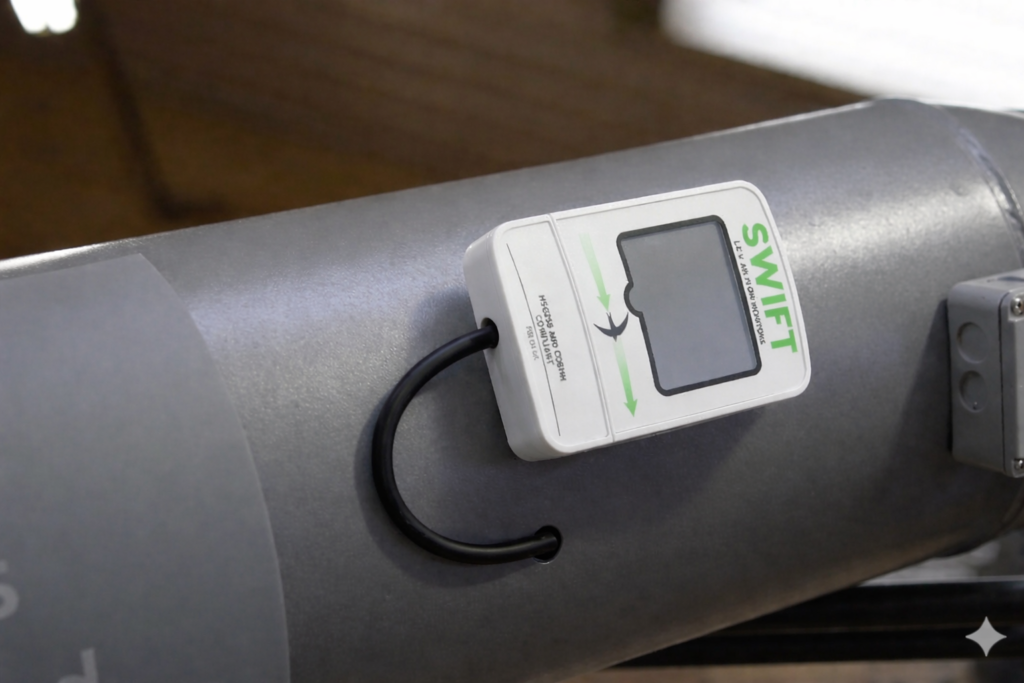
Clear, compliant airflow monitoring for LEV Systems
The SWIFT LEV Airflow Indicator is a highly visible, user-friendly airflow indicator designed to provide instant visual confirmation that your Local Exhaust Ventilation (LEV) system is operating correctly.
Recommended under HSE guidance* (HSG258), airflow indicators play a vital role in ensuring LEV systems continue to protect employees from hazardous airborne contaminants.
The SWIFT airflow indicator delivers simple, continuous monitoring of duct static pressure, providing operators with a clear, at-a-glance indication of safe or insufficient airflow. The SWIFT can be retrofitted to all LEV units regardless of make, model or age, thereby providing a common, easy to read monitor for all LEV units within a factory.
Speak to our sales team today about which SWIFT LEV airflow indicator is right for your business
What is an Airflow Monitor / Indicator?
An airflow indicator (also known as an LEV monitor is a device fitted to an LEV System to show whether airflow levels are adequate.
In any industrial ventilation system, airflow can reduce over time due to:
- Blocked ductwork
- Damaged pipework
- Fan failure
- Poor maintenance
- System modifications
An airflow indicator continuously monitors the static pressure inside the duct and provides a clear visual signal to the operator if the airflow is correct for the system or if it has moved outside of acceptable conditions
This ensures that hazardous dust, fumes and airborne contaminants are being effectively removed from the working environment (inline with the original LEV commissioning).
What is the SWIFT Air Flow Monitor for LEV systems?
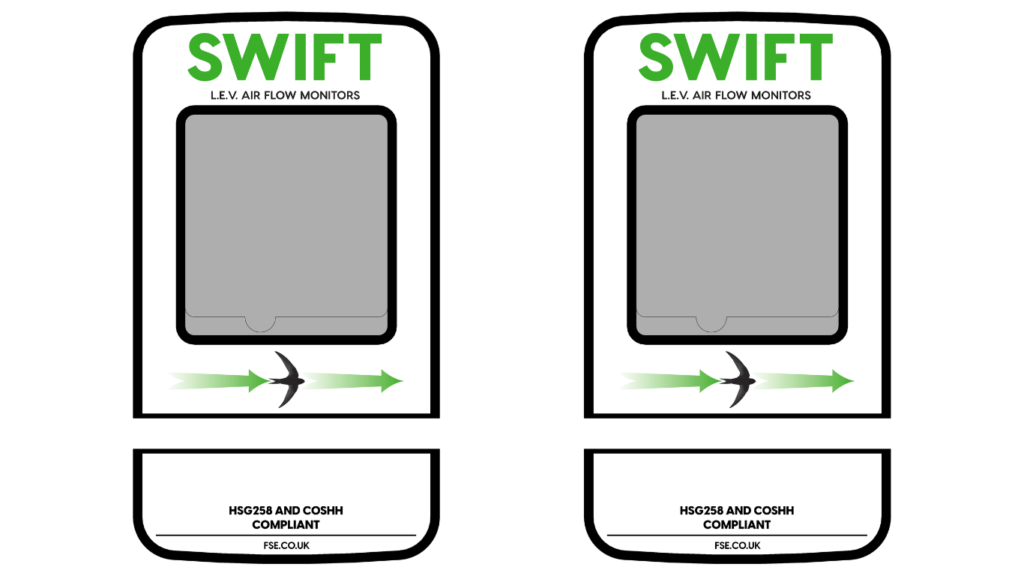
An LEV airflow indicator is specifically designed for Local Exhaust Ventilation (LEV) systems.
HSE guidance (HSG258*) states that operators must be able to tell that the system is working effectively. The simplest way to achieve this is by fitting airflow indicators at each extraction point.
The SWIFT airflow indicator is:
- Designed specifically for LEV systems
- Easy to install on new or existing ductwork
- Highly visible and operator-friendly
- Suitable for continuous monitoring
Fitting an airflow indicator helps bridge the gap between periodic Thorough Examination and Test (TExT) inspections by providing day-to-day reassurance that the LEV system is functioning correctly.
How the SWIFT Airflow Monitor Works
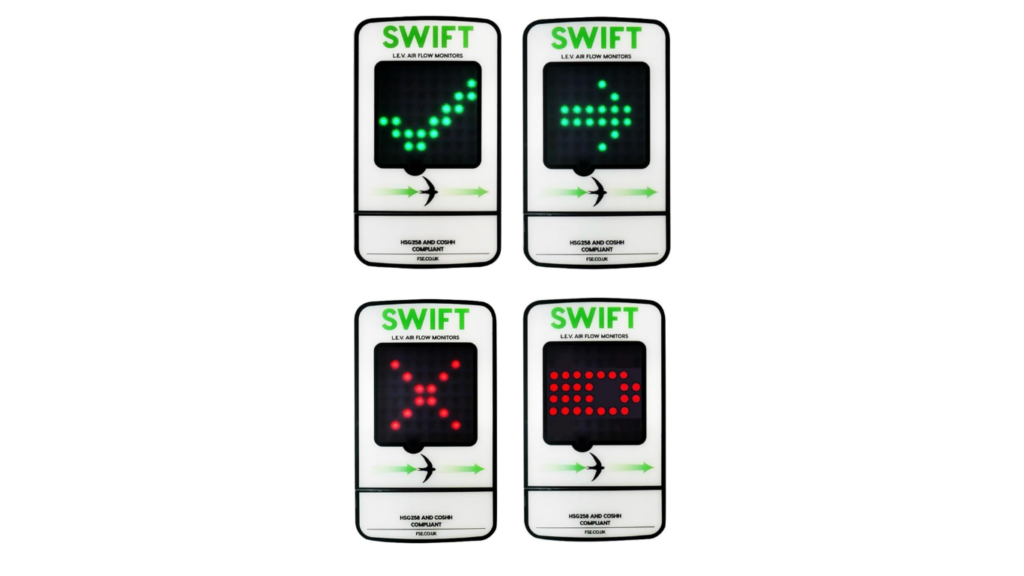
TThe SWIFT monitors airflow by measuring the static pressure within the duct, if the pressure changes by more than +/-20% of the calibrated set point, the swift indicates that the airflow is inadequate
Installation
A sample tube is fitted to the duct close to the extraction point. The unit can be mounted directly to the duct or to a nearby surface using banding, screws or bolts.
Calibration
Once installed and following commissioning of the LEV system, the unit is calibrated while the LEV system is operating correctly. Calibration takes only seconds.
Continuous Monitoring
The device samples static pressure at regular intervals.
If airflow remains within acceptable parameters, the display shows a continuous moving arrow.
If airflow drops outside of the defined operating region (i.e. -/+ 20% of original set point), a clear warning signal is displayed, alerting the operator immediately.
This airflow indicator design makes it instantly clear whether the system is safe to use.
What is the SWIFT Measuring?
LEV airflow indicators typically monitor static pressure, which is measured in Pascals (Pa).
Common duct pressure ranges in LEV systems may vary depending on system design, extraction point and airflow volume. The SWIFT airflow indicator is calibrated to the specific operating pressure of your LEV system to ensure accurate monitoring.
Benefits of the SWIFT LEV Airflow Monitor
1. Instant Visual Confirmation
Operators can see immediately whether airflow is adequate.
2. Improved Workforce Protection
Ensures continued protection against hazardous fumes, dust and airborne contaminants.
3. Supports COSHH & HSG258 Guidance
Helps employers demonstrate that LEV systems are being monitored for ongoing effectiveness.
4. Easy Installation
It can be retrofitted to existing ductwork or installed during commissioning.
5. Low Maintenance
Battery-operated with long service life and simple recalibration if system parameters change.
6. Suitable for Most Industrial Ventilation Systems
Compatible with a wide range of LEV duct pressure ranges.
Why Airflow Indicators are important for LEV Compliance?
Under COSHH regulations, employers must ensure that control measures — including LEV systems — remain effective.
While LEV systems must undergo periodic Thorough Examination and Test (TExT), airflow can change between inspections. Reduced airflow is one of the most common reasons LEV systems fail to protect workers effectively.
By fitting LEV monitors, employers:
- Provide a clear safety signal to operators
- Enable early identification of system faults
- Reduce the risk of hazardous exposure
- Support documented risk assessments
HSG258* identifies airflow indicators as a simple and practical way to check that airflow remains adequate.
SWIFT LEV Airflow Monitors supplied and installed by FSE
FSE supplies and supports SWIFT airflow indicators as part of a complete LEV extraction and compliance offering.
We provide:
- Supply of SWIFT LEV airflow indicators
- Installation and commissioning support
- Integration with existing industrial ventilation systems
- LEV testing and service support
- Ongoing technical advice
With decades of experience in LEV extraction and mist filtration systems, FSE ensures your airflow monitoring solution is correctly specified and installed.
Speak to our sales team today about which LEV airflow indicator is right for your business.
Contact us via email at sales@fse.co.uk or call us on 01562 60233
Coming soon… the new SWIFT+ LEV Airflow Monitor
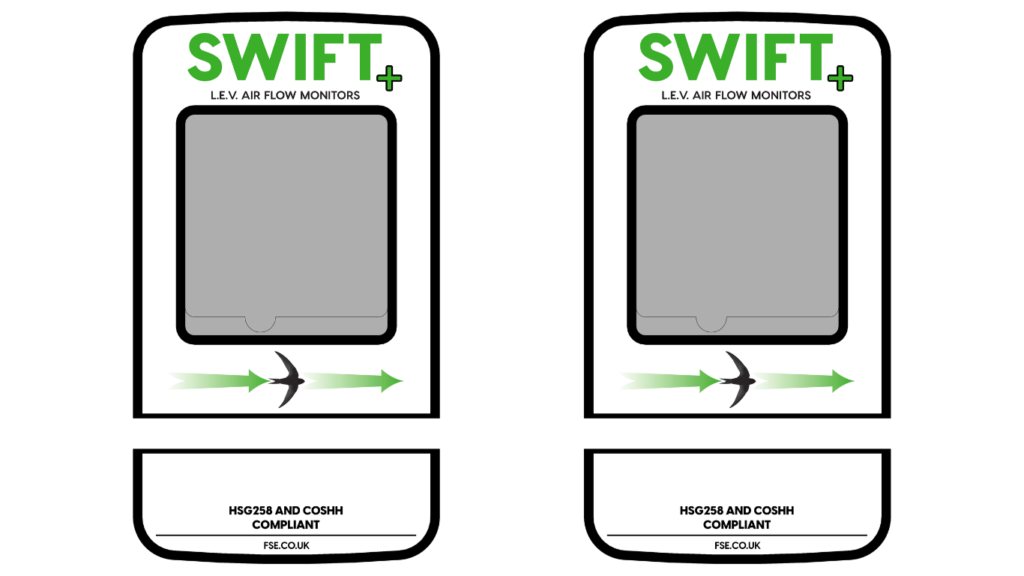
At MACH 2026, FSE will be launching a new SWIFT+ LEV airflow monitor
Benefits of the new SWIFT+ LEV Airflow Indicator:
- Real time alerts via SMS of all SWIFT+ units
Oil Mist Extraction & Management solutions from FSE
Whether you are replacing an existing system or upgrading your existing oil mist extraction & management solutions, FSE can help.
To speak to the FSE team today about oil mist extraction & mist management solutions to suit your business, contact us at sales@fse.co.uk or 01562 60233 or by using our online enquiry form.
Frequently asked questions about SWIFT LEV Airflow Indicators
An airflow indicator is a device fitted to an industrial ventilation system to show whether airflow is adequate.
In a Local Exhaust Ventilation (LEV) system, the airflow indicator provides a clear visual signal to operators confirming that hazardous dust, fumes or airborne contaminants are being properly extracted.
Airflow indicators are also known as:
- LEV monitors
- Air flow indicator AFI
- Chevron airflow indicators
- LEV air flow gauges
All serve the same purpose — confirming that the LEV system is working effectively.
What is the air flow indicator for LEV systems?
An LEV airflow indicator is specifically designed for Local Exhaust Ventilation systems. It monitors duct static pressure and provides a simple visual display to confirm whether airflow remains within safe operating parameters.
HSE guidance (HSG258) recommends that operators must be able to tell if the hood airflow is adequate. The simplest and most practical way to achieve this is by fitting airflow indicators at each extraction point.
Airflow indicators are strongly recommended under HSG258 (HSE guidance on LEV systems).
While not always explicitly stated as a mandatory device, employers are legally required under COSHH regulations to ensure LEV systems remain effective.
Fitting a LEV airflow indicator is widely considered a “reasonably practicable” control measure because it:
- Provides continuous airflow monitoring
- Alerts operators to faults immediately
- Supports compliance during LEV Thorough Examination and Test (TExT) inspections
If you choose not to fit airflow indicators, you may need to justify this decision within your risk assessment documentation.
LEV airflow indicators typically measure static pressure, which is expressed in Pascals (Pa).
The indicator monitors negative pressure within the extract duct. A reduction in pressure can indicate reduced airflow, blockage, fan failure or system damage.
The SWIFT airflow indicator is calibrated to the normal operating pressure of your specific LEV system.
An LEV airflow indicator is specifically designed for Local Exhaust Ventilation systems. It monitors duct static pressure and provides a simple visual display to confirm whether airflow remains within safe operating parameters.
HSE guidance (HSG258) recommends that operators must be able to tell if the hood airflow is adequate. The simplest and most practical way to achieve this is by fitting airflow indicators at each extraction point.
Airflow indicators are strongly recommended under HSG258 (HSE guidance on LEV systems).
While not always explicitly stated as a mandatory device, employers are legally required under COSHH regulations to ensure LEV systems remain effective.
Fitting a LEV airflow indicator is widely considered a “reasonably practicable” control measure because it:
- Provides continuous airflow monitoring
- Alerts operators to faults immediately
- Supports compliance during LEV Thorough Examination and Test (TExT) inspections
If you choose not to fit airflow indicators, you may need to justify this decision within your risk assessment documentation.
LEV airflow indicators typically measure static pressure, which is expressed in Pascals (Pa).
The indicator monitors negative pressure within the extract duct. A reduction in pressure can indicate reduced airflow, blockage, fan failure or system damage.
The SWIFT airflow indicator is calibrated to the normal operating pressure of your specific LEV system.
An Air Flow Indicator (AFI) for LEV systems measures duct static pressure in Pascals (Pa).
It does not directly measure airflow volume (such as m³/h). Instead, it uses static pressure as a reliable indicator that airflow is within safe control limits.
A chevron airflow indicator uses a highly visible moving display (chevron arrow) to show that airflow is adequate.
- A continuously moving chevron indicates safe airflow.
- A warning symbol or flashing alert indicates insufficient airflow.
The system samples duct static pressure at regular intervals and compares it to the calibrated safe value. If pressure drops beyond a set threshold, the unit alerts the operator immediately.
Reduced airflow is one of the most common reasons LEV systems fail to protect workers effectively.
Fitting a LEV airflow indicator helps to:
- Protect employees from hazardous dust and fumes
- Identify system faults early
- Reduce risk between annual LEV tests
- Support COSHH compliance
- Provide visible reassurance to operators
It is a simple, low-cost safety improvement for any industrial ventilation system.
Yes. SWIFT LEV airflow indicators can be installed on both new and existing industrial ventilation systems. They can be mounted directly onto ductwork or fitted to a nearby surface, with flexible tubing connecting to the duct.
This makes them ideal for upgrading older LEV systems to improve compliance and safety visibility.
The airflow indicator itself continuously monitors system pressure. However:
- Battery condition should be checked during routine maintenance.
- Calibration should be verified if major system changes occur.
- LEV systems must still undergo Thorough Examination and Test (TExT) at least every 14 months under COSHH Regulation 9.
The airflow indicator does not replace statutory testing but provides continuous monitoring between inspections.
If airflow drops below the calibrated safe level, the SWIFT airflow indicator will clearly display a warning signal.
This may indicate:
- Fan failure
- Duct blockage
- Damaged ductwork
- Incorrect damper position
- Filter restriction
Immediate action can then be taken before operators are exposed to hazardous airborne contaminants.
*These notes are for guidance only and are application dependant. This webpage is not definitive and must be used in conjunction with the latest relevant HSE document/s:
HSG258 “Controlling airborne contaminants at work; A guide to local exhaustive ventilation (LEV)” Version 2.4
HSE/UKLA “Good Practice Guide for Safe Handling and Disposal of Metalworking Fluids”
B.O.H.S/F.O.H “Guidance for occupational Hygienists on the Assessment and Control of Health Risks from Metalworking Fluid” V1.1 Mar 2025
E&OE
Always check for the latest revision